|
|
||
|
|
|
|
How a Sextant Works
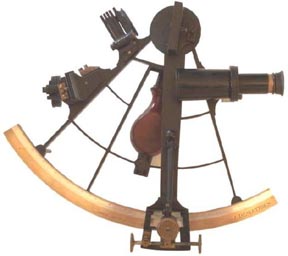
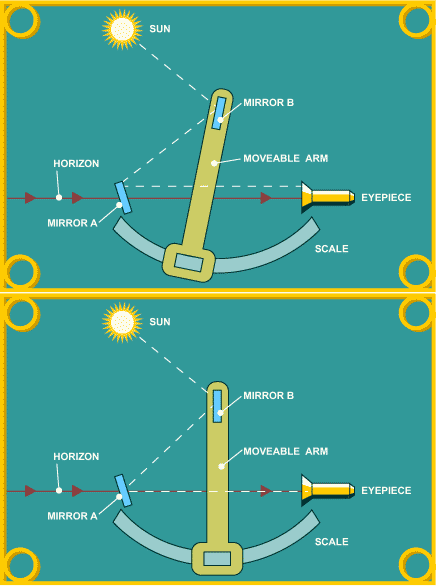
There's nothing mystical or complicated about a sextant. All it is is a device that measures the angle between two objects. The sextant makes use of two mirrors. With this sextant, one of the mirrors ( mirror A in the diagram) is half-silvered, which allows some light to pass through. In navigating, you look at the horizon through this mirror.
The other mirror (mirror B in the diagram) is attached to a movable arm. Light from an object, let's say the sun, reflects off this mirror. The arm can be moved to a position where the sun's reflection off the mirror also reflects off mirror A and through the eyepiece. What you see when this happens is one object (the sun) superimposed on the other (the horizon). The angle between the two objects is then read off the scale. What makes a sextant so useful in navigation is its accuracy. It can measure an angle with precision to the nearest ten seconds. (A degree is divided into 60 minutes; a minute is divided into 60 seconds.)
|
|
||
 Coastal Boating (Reg. in Ireland No. 443222) is a division of Knowledge Clinic Ltd. Coastal Boating (Reg. in Ireland No. 443222) is a division of Knowledge Clinic Ltd.Europe: Port Aleria, Rosnakilly, Kilmeena, Westport, Co. Mayo, Ireland - USA: PO Box 726, Mahwah, NJ 07430 All content on this site is subject to Copyright© - All rights reserved. Contact us - Advertising - Privacy - Terms & Conditions - Copyright & Trademark - Webmaster |