|
|
||
|
|
|
|
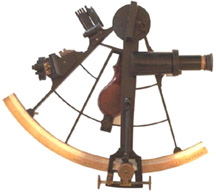
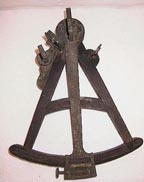
Are these sextants, or are they octants?
Measurement of the "lunar distance", the angle-in-the-sky between the Moon and the Sun or a star or planet, however, was much more demanding. An accuracy of better than one minute of arc was required to limit the error in longitude within 30 minutes (30 miles, near the equator). For this purpose, a brass instrument was considered necessary because wood did not provide the necessary long-term dimensional stability. Lunar-distance angles could usefully be measured up to 120 degrees and sometimes more. (For this purpose, the quintant, measuring to 144 degrees, was introduced in the late 19th century.)
When a navigator possessed an accurate metal sextant, he might well reserve that precious device for use in measuring lunar distances, and bring out his wooden octant for the simpler task of measuring altitudes above the horizon. When the chronometer eventually became cheap enough to be available to the ordinary mariner, lunar distances became obsolete (except for those careful souls who liked to make a cross-check on their chronometer). So the old wooden octants remained in use by some navigators, well into the 19th century, doing all that was then needed. George Huxtable
|
|
|||
 Coastal Boating (Reg. in Ireland No. 443222) is a division of Knowledge Clinic Ltd. Coastal Boating (Reg. in Ireland No. 443222) is a division of Knowledge Clinic Ltd.Europe: Port Aleria, Rosnakilly, Kilmeena, Westport, Co. Mayo, Ireland - USA: PO Box 726, Mahwah, NJ 07430 All content on this site is subject to Copyright© - All rights reserved. Contact us - Advertising - Privacy - Terms & Conditions - Copyright & Trademark - Webmaster |