|
|
||
|
|
|
Why it’s better for women to take the helm |
|
||||||||||||||||||||||
Why it’s better for women to take the helmOne woman’s cruising…and learning…experienceBy
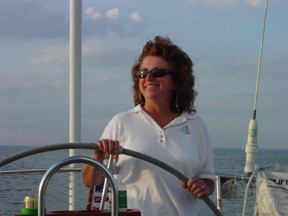
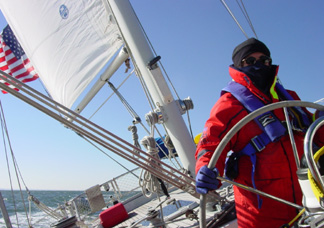
Based on personal observation, times seem to be changing. I’ve been seeing more and more women at the helm, often with no one else in evidence onboard. That is very encouraging because it means women are finally getting the confidence to go out there and do it without fear. I’ve actually found that if I had known how much easier it is to be at the helm than in any other job on the boat I would have taken it up decades sooner. Most important is that handling a boat with the confidence to get yourself, your passengers, and your vessel to safe harbor no matter what the circumstances is a safety consideration you can't afford to ignore. Getting started I’ve been sailing since I was 15 when a friend taught me how to handle a Sunfish on
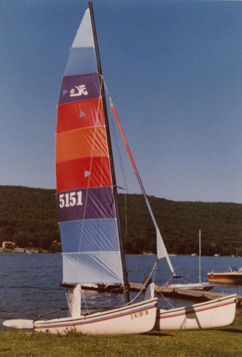
A boat of my ownAfter that first fateful summer, I didn’t sail again for a few years until I started renting Hobie 16s every time I saw one on a beach. I had never sailed them before but they looked like fun and after watching sailors from the beach, I felt sure it couldn’t be much different than handling a Sunfish. Naturally, I was wrong, but I wasn’t that far off and I am so glad I took the leap. My philosophy has always been that if I wait for someone to do it with, it’s not likely to happen. So I’ve jumped into things on my own if I wanted something badly enough. Sailing was one of them. And that, in itself, was a pivotal learning experience. One formative experience occurred when I was 19 and in the
That is how I learned my first very valuable lesson about making sure people really do understand what they’re getting into and the importance of ‘staying on the boat’. I also learned how sailing short-handed or solo could be much easier – and more satisfying. After that, I found myself renting Hobies for a couple of hours as often as I could, in the islands, at the shore, and on lakes, but this was never nearly often enough. It wasn’t until I got married that I fulfilled this dream – a boat of “my own”. We bought a Hobie 18 and my dreams started to grow. We trailered that Hobie up and down the eastern seaboard from
Stepping UpOur next venture was chartering keelboats for day sailing, first J24s on the
That weekend, despite the challenges, the bug bit hard. Swinging round on the mooring and rocking gently like in a cradle, I had never felt more comfortable any place else in the world. Going on deck at night, I realized that it had been years since I had actually looked at the night sky. There was beauty here that one cannot experience in a city. The sea around me was teaming with life. Phosphorescence was trailing behind fish and crabs swimming gracefully through the dark water. It was truly magical. Soon we were the proud owners of a Sabre 36. We kept her on the
Then, with the end of that marriage came the temporary end of a dream. I had to sell the boat. I was the one who had to put her on the market, work with the broker, find the buyer, and sign her over. I cried all the way from
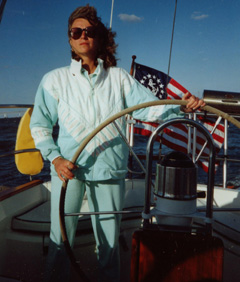
Why didn’t I take the helm and keep the boat?So what is it that stopped me and countless other women from taking the helm when it counted the most? And when did that change for me? Why do we take responsibility in business and at home, but not on the boat? I was at the helm, as President, of a major advertising agency. So, why didn’t I believe I could handle a boat on my own? Looking back on what I know now, I don’t get it. I just don’t know why I was so intimidated. Perhaps we women just don’t have the role models. Or maybe we are afraid of exposing our lack of experience. Then again, maybe we just don’t like being yelled at. Many women feel they have to be perfect before attempting something. But somehow, we just don’t take the helm when it matters often enough to get even close to perfection. Men just do it and worry about the consequences later. At the time, I didn’t believe I could manage that beloved boat alone, and I was too afraid of failure to try. Now I know differently. I see more and more women taking the helm proudly and confidently and sailing off to their dream worlds. Were it to happen now, no one could part me from that boat I sold, nor the dream it represented. Ratcheting up the confidence levelFast forward to another time and life with Alex, my husband, friend and trusted partner in everything worthwhile. Fast forward, too, to finding the courage I always had to take the helm as skipper for all maneuvers. I quickly learned a couple of lessons I’d like to share with you. Hopefully, it’ll help you avoid wasting decades of hard labor. Here it is:
2) It’s so much easier to be at the helm than
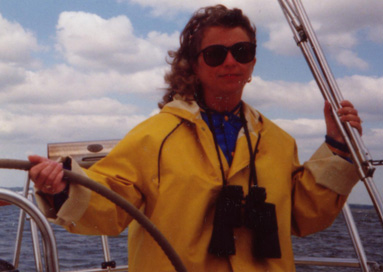
If I had only known, I would have taken the helm years earlier and not let go. Today, we share it all; I’m a helmsman, tactician, and navigator. We both need to know how to do everything on board – at least enough to deal with a problem reasonably effectively. That way, if something happens to one of us, the other will still be able to get us to safety. And that goes both ways. It means Alex has had to learn navigation, provisioning, radio operations and medicine. I can handle the helm under most conditions; hoist, trim and reef sails; navigate using DR as well as electronics; apply radar for collision avoidance and navigation; and hold my own in discussions with tugboat and tanker captains about right of way. I still do the major provisioning, but I no longer mind..
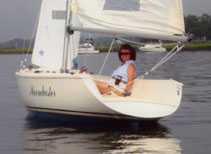
I actually planned to overcome my shortcomings very methodically. I started taking courses in all the things I wasn’t comfortable with just to validate my knowledge. I got certified, rectified, and bona fide. Lo and behold, I discovered I knew alot more than I thought I did. But in sailing you will never know it all - that's part of the allure. I studied diesel mechanics (yes, I took a two day, in-depth course), weather prediction, coastal navigation, and radio operation. I have my HAM radio license, CPR and first aid certifications for both humans and animals (we sail with our cruising kitty, Onyx), and advanced coastal navigation certificate. I also secured a one ton USCG OUPV Captain's License. With each accomplishment, I checked off another misgiving. No, I can’t just fix an engine, but I do know how to go about diagnosing a problem and looking up a solution. I can plot our way in the absence of electronics (we’ve had complete power failure twice now) and in the presence of fog. I can bandage wounds and broken bones, treat shock and exposure, and attempt to resuscitate a drowning or heart attack victim. I can call for assistance on any radio – VHF, SSB, and HAM. I can route us around weather systems, prepare for the worst when it arrives, and hopefully get us through it if we get caught in it. I’m not an expert in any of these things, but I am competent and confident in my ability to act responsibly in a tough situation. But I had to “do it” and prove it to myself first. As I mentioned, I had often taken the helm underway while cruising. I could tack and jibe, hold a course upwind and downwind, navigate and otherwise manage a boat underway. It was the starts and stops that were daunting for some odd reason. Practice makes for comfortI started with taking the helm while mooring, which turned out to be so ridiculously easy that I was startled. (Perhaps I’d learned from all the mistakes I’d witnessed over the years.) I next attempted docking under power while the wind was calm, then worked my way to docking with the wind blowing, the tide running, and approaches more challenging -- like coming in aft-to into a slip. Piece of cake. In fact, I was always so prepared that it just seemed easy. And I was pretty good at it. That’s when I realized that the reason people have problems is that they come in unprepared. They don’t have their dock lines set, they are still fumbling with fenders, they come in too fast, and they don’t observe the natural forces – wind and currents. If you come in prepared, your chances of getting it right are pretty high unless nature takes its toll in conditions you couldn’t have predicted. Then, anyone would have difficulty. But that’s not the usual situation. Ask yourself, what’s the worst that can happen? You’ll miss the mooring and have to try again. Just don’t foul the prop on the mooring line and you’ll be fine. Work your way up. Try docking in calm conditions, in slack water, going very slowly to learn how your boat behaves. Go a little faster if you lose steerage, slower if you’re uncomfortable. Don’t let anyone intimidate you. You’re at the helm. You’ll soon get a good sense of the boat’s momentum – how long it takes her to accelerate and slow down, both in forward and reverse. Drive her around in reverse in an empty harbor in both directions just to see how she acts. Most boats have a little sashay action in one direction or the other (called prop walk) which can act to your advantage if you know about it. Once you get that one under your belt…contemplate what happens if the engine quits? What’s plan B? Can you sail her up to an unoccupied mooring without auxiliary power? You bet you can! It’s easy once you’ve done it. Just come around, point her into the wind and at the mooring ball, pick up and secure the mooring line, and drop the sails. Piece of cake. If you miss the mooring, just fall off and try again. I got to the point where I could easily pick up a mooring completely on my own. You don't have to run to the bow. You can drive up, pick it up at the stern, walk the line forward and, voila, you're tied up. It only took a bit of practice. One thing that helped a lot was practice sailing up to a mooring and alongside a dock in a small
The last step was being out there by myself – really. The first time I went out for a sail alone on our Frers 41 was one of the most exhilarating experiences of my life. I was a little nervous I must admit, but more excited than nervous. It was a beautiful day. The wind was a steady 10 knots, the sky was blue, the sun was bright and the air warm. You couldn’t ask for more. As I checked the oil, started the engine, and dropped the mooring lines, I felt this enormous sense of freedom. Then, I hoisted the sails, killed the engine, and headed out into the Sound. It was so quiet. I could do this. I could sail away all on my own, into my own world for a few hours and the world wouldn’t end. When it was time to head back in, I felt almost sorry but exalted. Once I got to the mooring and managed to tie her up I had accomplished something major. I’d done it. I was no longer helpless. In fact, I liked it so much I kept going out on my own whenever I got the chance. I got so comfortable that when Alex couldn’t make the yacht club spring cruise I asked a couple of friends to join me on Espresso and we raced. Yep, I was at the helm and actually had a pretty good start in a stiff 25 knot breeze and reefed main. But that’s another story. In general, I really don't like going around in circles. Racing destroys the serenity of sailing for me. We routinely sail overnight to extend our cruising grounds, just the two of us and the cat. We take 3-hour on/3-hour off shifts at the helm, during which time we are each alone on deck and solely responsible for our entire world. What a magical time. To watch the moon rise like a burning ship over the horizon. To find the sun breaking through the mist of the morning. To corroborate your presumed position by counting the flashes from that lighthouse you sighted. You don’t have to go that far. You just have to take the helm as far as your interests take you. But you never know…
So where am I now? I learned the ropes in the small Ideal 18, and transferred this knowledge and confidence to our 41’ sloop, Espresso. Just as I developed a special relationship with her, we found “the boat of our dreams”. She is a vintage Bowman 57 ketch. She's a bit more than one can handle on one's own for long stretches, but Alex and I have crossed the Atlantic three times in three years, double handing each time across at different latitudes. We took a year's sabbatical and sailed the Atlantic and Caribbean. It was an amazing experience in which we were each, on our respective watches, responsible for our entire world. For as one takes command the other sleeps for three weeks, the time it takes to get across. We witnessed the most amazing sights and experienced intense challenges. We'll never look at the world the same way again after this life changing experience. And yes, I was proud of my accomplishments, which would have never been possible without taking the helm firmly in my grasp and navigating across the oceans. Daria Blackwell is a consummate sailor who had been cruising the Eastern Seaboard of the United States together with her husband, Alex, and cruising kitty, Onyx, for years on their Frers 41 sloop Espresso and then on their Bowman 57 cutter rig ketch Aleria, while working at “normal” jobs to build up the other cruising kitty. They sailed off in 2008 to do a spiral around the Atlantic. Daria is a member of the Ocean Cruising Club and serves as the Press and Digital Communications Officer and a member of the Seven Seas Cruising Association. Daria and Alex now live in Ireland and serve as Port Officers for OCC and Cruising Station for SSCA. They are members of Mayo Sailing Club and American Yacht Club. The are co-authors of the highly acclaimed book, "Happy Hooking. The Art of Anchoring." which is available in both print and Kindle editions. They have created a course on anchoring for NauticEd and conduct webinars for Seven Seas University. Daria holds a USCG OUPV Captain's License. Click here for more on Famous women of the sea (including our ancestor Grace O'Malley)
|
 Coastal Boating (Reg. in Ireland No. 443222) is a division of Knowledge Clinic Ltd. Coastal Boating (Reg. in Ireland No. 443222) is a division of Knowledge Clinic Ltd.Europe: Port Aleria, Rosnakilly, Kilmeena, Westport, Co. Mayo, Ireland - USA: PO Box 726, Mahwah, NJ 07430 All content on this site is subject to Copyright© - All rights reserved. Contact us - Advertising - Privacy - Terms & Conditions - Copyright & Trademark - Webmaster |